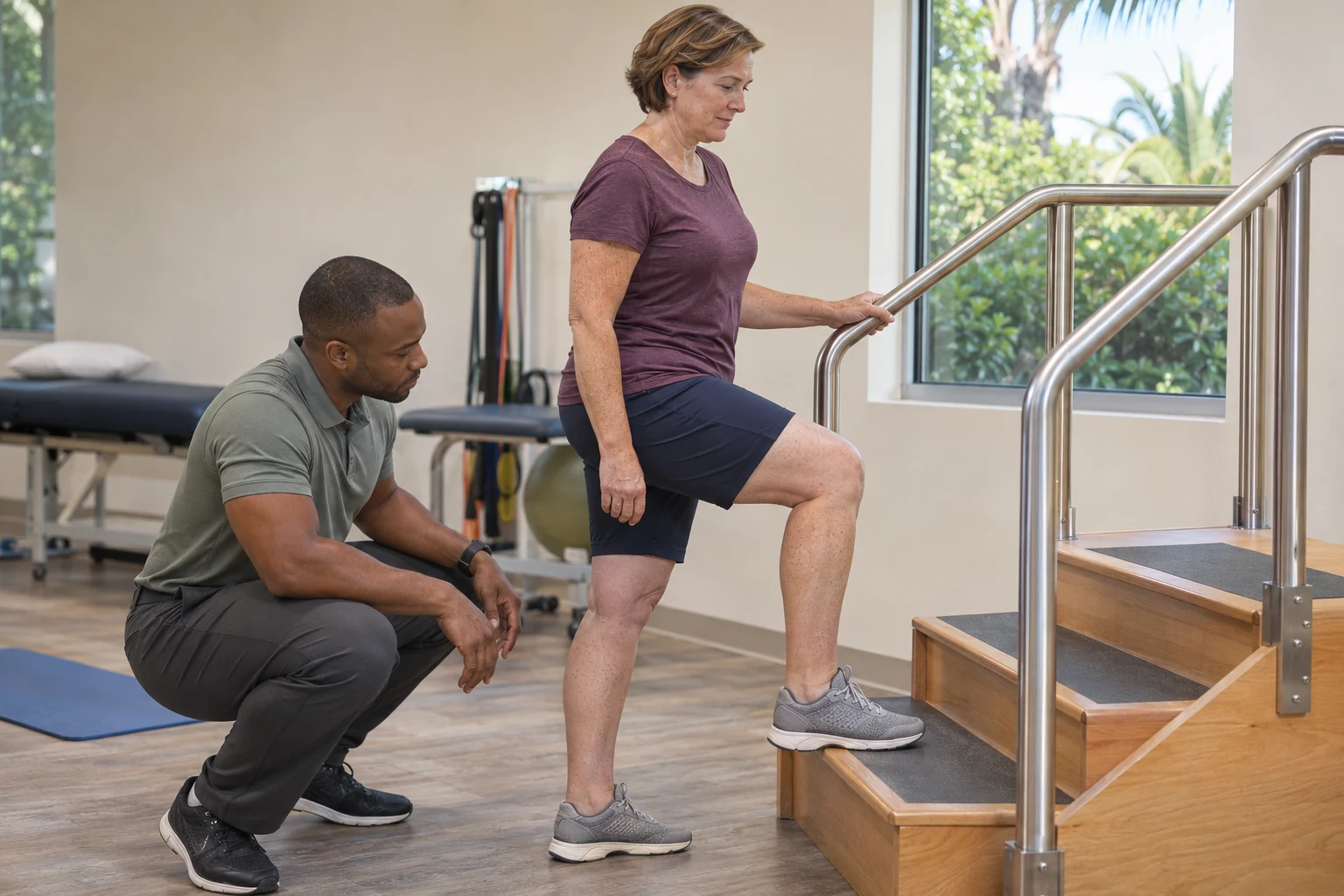
Knee pain on stairs is often linked to irritation behind the kneecap, tendon overload, early arthritis, or weakness in the hips and thighs. A physical therapy evaluation measures strength, motion, and how you climb and descend to pinpoint the cause. Our team provides physical therapy in Tarzana, CA with one-on-one care and a clear plan. Schedule your evaluation to get moving comfortably again.
Stairs are one of the first places knee problems show up. You might feel a sharp pinch climbing to the second floor, an ache going down, or a grinding sensation behind the kneecap that makes you reach for the handrail. At Theracare Physical Therapy, we help patients from Tarzana and the surrounding San Fernando Valley understand why stairs hurt and what a structured physical therapy program can do about it.
This guide walks through the most common causes of knee pain on stairs, explains each part of a physical therapy evaluation, and describes what treatment typically involves. If you are ready to be seen, you can book an appointment at any of our clinics.
Why Do My Knees Hurt on Stairs?
Stairs place far more load on the knee than walking on level ground. Going up is a power movement: your quadriceps and glutes lift your body weight against gravity, which presses the kneecap against the thigh bone. Going down is a control movement: the quadriceps lengthen under tension to slow you down, placing high stress on the patellar tendon and the knee's stabilizing structures. That is why many patients notice their pain more on stairs than anywhere else, and why our physical therapists always test both directions.
Knee Pain Going Up Stairs
Pain on the way up often relates to the joint behind the kneecap, called the patellofemoral joint. Irritated cartilage, weak quadriceps, or poor hip control can all increase pressure there. Patients with arthritis may also feel stiffness and aching as the joint bends under load, something our pain management physical therapy addresses directly.
Knee Pain Going Down Stairs
Pain on the way down is frequently connected to patellofemoral pain, patellar tendinopathy, or general instability. Because descending requires controlled, lengthening muscle work, weakness in the quadriceps and glutes tends to show up here first. Athletes with this pattern often benefit from sports rehabilitation once the initial irritation calms down.
Common Causes of Knee Pain on Stairs
Several conditions can produce stair-related knee pain. A careful evaluation at our Tarzana physical therapy clinic is designed to tell them apart:
- Patellofemoral pain syndrome: Pain around or behind the kneecap that worsens with stairs, squatting, and sitting with bent knees, often helped by targeted strengthening
- Knee osteoarthritis: Wear-related joint changes that cause stiffness, swelling, and aching under load
- Patellar or quadriceps tendinopathy: Tendon irritation from repeated loading, common in runners and active adults
- Meniscus irritation or tears: Pain, catching, or locking, particularly with twisting or deep bending
- Ligament injuries: Instability after an ACL or collateral ligament injury, which may need post-surgical rehabilitation if surgery was performed
- IT band irritation: Pain on the outside of the knee, frequently linked to hip control
- Kinetic chain problems: Weak hips, stiff ankles, or altered walking patterns that shift extra load onto the knee
Pain does not always start where it hurts. Some patients who come in for knee pain also have back pain that returns after sitting, and changes in how they move to protect one area can overload another.
What a Physical Therapy Evaluation Looks Like
Your first visit is about finding the cause, not simply treating the symptom. Every plan at Theracare starts with a thorough evaluation of movement, strength, and pain patterns, an approach outlined on our physical therapy service page. Here is what that typically includes for knee pain on stairs.
1. Your History and Goals
Your physical therapist begins by listening. Expect questions about when the pain started, whether it is worse going up or down, whether there was an injury, what activities you have given up, and what you want to return to. Previous surgeries, imaging results, and other joint problems are also discussed. These details help our experienced physical therapists narrow down the likely cause.
2. Observation of Stairs and Functional Movement
Because stairs are the problem, your therapist will often watch you step up and down, perform a single-leg squat, or rise from a chair. They look for the knee drifting inward, hip drop, trunk lean, or a stiff ankle. These patterns often explain why pain appears on stairs, and they guide the exercise choices in your knee pain treatment plan.
3. Range of Motion and Joint Assessment
Your therapist measures how far the knee bends and straightens and checks the hip and ankle as well. Kneecap mobility, swelling, and joint tenderness are assessed by hand. Limited motion in any of these areas can change how force travels through the knee, which our hands-on manual therapy is designed to improve.
4. Strength and Muscle Testing
The quadriceps, hamstrings, glutes, hip rotators, and calf muscles are tested and compared side to side. Weakness in the hips and thighs is one of the most common findings in patients with knee pain on stairs, and building that strength is central to treatment at our physical therapy clinic in Tarzana.
5. Special Tests and Palpation
Specific hands-on tests help assess the ligaments, meniscus, kneecap, and tendons. Your therapist will also check where the knee is tender. If anything suggests a problem that needs imaging or a physician's opinion, you will be told directly and referred appropriately, consistent with the evidence-based approach described on our About page.
6. A Clear Explanation and Plan
At the end of the evaluation, you will receive a plain-language explanation of what is causing your pain, what treatment will involve, and a realistic timeline. You will usually leave with your first home exercises. Plans are reassessed regularly and adjusted as you progress, so your care stays matched to your needs. You can review our full list of physical therapy services to see how other treatments may fit in.
How Physical Therapy Treats Knee Pain on Stairs
Treatment is built around the specific findings from your evaluation. Most plans for knee pain physical therapy combine several of the following:
- Targeted strengthening: Progressive work for the quadriceps, glutes, hamstrings, hips, and core, including step-ups, squats, bridges, and controlled step-downs
- Hands-on manual therapy: Joint mobilization and soft tissue work to restore motion and ease pain
- Movement retraining: Practice climbing and descending stairs with better alignment and control
- Flexibility and mobility work: For the hips, thighs, calves, and ankles
- Activity guidance: Short-term changes such as using the handrail or taking stairs one at a time while strength improves
- Recovery support: Cryotherapy to calm swelling and soreness, and red light therapy to support tissue recovery between sessions
- Home exercise program: Simple exercises you can do between visits to keep progressing
Sessions are one-on-one, and progress is tracked at each visit. Many patients notice meaningful improvement within a few weeks, though timelines depend on the underlying condition and how long symptoms have been present. Patients with chronic arthritis pain can also benefit from our pain management services.
When to See a Physical Therapist for Knee Pain
Occasional soreness after a long hike is normal. Consider booking a physical therapy evaluation in Tarzana if you notice any of the following:
- Knee pain on stairs that has lasted more than a couple of weeks
- Pain that is getting worse or spreading to other activities
- Swelling, catching, locking, or a feeling that the knee may give way
- Avoiding stairs, hills, or exercise because of pain
- Knee pain after a fall, twist, or sports injury
- Ongoing stiffness after knee surgery such as an ACL reconstruction, meniscus repair, or knee replacement
If your knee is suddenly very swollen, cannot bear weight, looks deformed, or is hot and red with fever, seek medical care promptly. Once serious causes are ruled out, our team can guide your recovery through physical therapy or post-surgical rehabilitation.
How Long Does It Take to Feel Better?
Recovery time depends on the cause of your knee pain, how long it has been present, and how active you need to be. Irritation behind the kneecap or mild tendon overload often responds within several weeks of consistent strengthening, while arthritis-related pain usually improves gradually as the muscles around the joint get stronger. Your therapist will set realistic milestones, such as climbing a flight of stairs without the handrail or returning to walking hills, and review them at each visit in your physical therapy plan. Patients recovering from a knee replacement or ACL reconstruction follow a longer timeline through our post-surgical rehabilitation program.
Do You Need a Referral?
California allows direct access to physical therapy, so many patients can be seen without a physician referral. Some insurance plans still require one, and coverage varies. Our team will verify your insurance benefits before your first visit so there are no surprises.
Knee Pain Physical Therapy Near Tarzana
Since 2017, Theracare Physical Therapy has treated more than 1,000 patients, with care led by a Doctor of Physical Therapy who has more than 20 years of experience in orthopedics and sports rehabilitation. The practice reports a 95% patient satisfaction rate and focuses on restoring function rather than simply masking pain.
Our Tarzana clinic is located at 18607 Ventura Blvd, Suite 106, and is convenient for patients from Encino, Reseda, Woodland Hills, and Sherman Oaks. We also have clinics in Newhall and Granada Hills, listed on our locations page.
Get Back to Climbing Stairs Without Pain
Knee pain on stairs is common, but it is not something you need to work around forever. A trusted, thorough evaluation identifies the cause and gives you a clear plan to fix it. Call (818) 975-8203 or request a free consultation with our physical therapy team in Tarzana today.